A portfolio is not a bigger marina — it is twenty, or ninety, or a hundred and fifty different ones. Different layouts, different berth numbering, different maintenance history, most of it in someone's head. HarbourMate brings every site to the same representation without replacing the systems each one already runs.
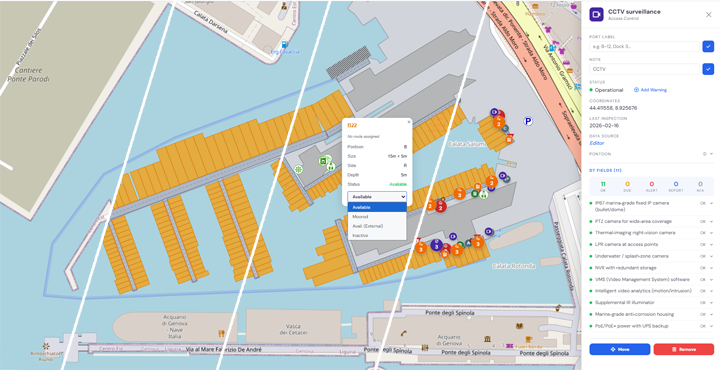
The same map a marina publishes on its own website: it opens in the browser, no login, no app. Move it around.
Acquiring marinas is fast. Making them comparable is not.
Every site was drawn by a different hand in a different decade. Berth counts do not reconcile, numbering follows local habit, and the plan on the wall is not the plan in the file. There is no single view of what the group physically owns.
The service level at each marina is held by the harbour master who has been there fifteen years. It works — until that person is on leave, retires, or the group wants the same standard applied at a site acquired last month.
Insurers, auditors, lenders and buyers all ask the same question: what is there, in what condition, inspected when. Assembling that answer site by site, by hand, is the cost nobody budgets for.
The same customer berths at three marinas in the same group and is guided in three different ways — or not guided at all. The brand is one; the arrival is not.
Standardisation is not a policy document. It is the same four things existing for every marina in the portfolio, in the same shape, exportable at any time.
Pontoons, berths with their real dimensions, depths, service points and the approach into the basin — as geospatial data, not as a drawing.
Every berth carries a stable identity across the group, while keeping the local name the staff actually use on the radio.
Safety equipment, utilities, structural elements — catalogued against the map, with inspection checklists, due dates and work orders attached to the object itself.
Every marina's data belongs to that marina and to the group that owns it, and can be exported in full, at any moment, for reporting, diligence or migration.
Each marina is its own tenant: its own data, its own users, its own permission matrix. A portfolio is not a workaround on top of that — it is what the design was for.
Local staff work in their own marina and see their own data. Roles and permissions are configured per site, so a dockmaster in one location has no reach into another.
Group-level access reads the same underlying twin for every marina — the same categories, the same asset structure, the same inspection states.
Portfolios rarely run one booking system. HarbourMate sits above them: integration is per site through its API, and where a site has no system at all, nothing breaks.
No hardware at the marina, no software on staff machines, no app for guests. A browser is the whole requirement.
Each marina starts from the documents it already has. We build the site and hand it back working — nobody is asked to learn a system before there is something of theirs to look at.
The berth plan and the berth list, in whatever form they exist. We do the transcription. Sites with nothing usable are surveyed instead, and quoted separately.
A portfolio spanning several regions has several seasons. Sites are built when they have time and go live when they have boats — Mediterranean and Gulf, northern Europe, Florida, each on its own calendar.
Start with a cluster of sites, not the whole portfolio. What the group learns there sets the terms for everything that follows.
An association does not own its members' marinas and cannot decide for them. What it can do is open the door once, for everybody.
The association forwards the offer to its members. Each marina decides on its own and contracts on its own. No commitment is made on anyone's behalf.
Aggregated findings from participating members return to the association first — what the sector actually does, measured rather than surveyed.
The published price list is built for a single marina. For a group the variables are the number of sites, how much usable documentation exists, and how many seasons the rollout spans.